Revitalizing Science Education Through Playful Visual Storytelling
Education holds an essential role in creating a better future. It is the bedrock upon which societies build innovation, empathy, and progress. Central to this mission is the development of students’ critical thinking skills through dynamic teaching-learning activities. However, educators face a persistent challenge: maintaining the attention of younger learners who are increasingly accustomed to fast-paced digital stimuli. Many students find traditional lecture formats challenging to follow, not because they lack intelligence, but because the material presentation fails to resonate with their natural curiosity.
The disconnect often lies in the delivery method. When scientific concepts are presented as dry facts or dense text blocks, the inherent wonder of discovery is lost. Hence, as a teacher, you need to keep their focus through an exciting lesson presentation that bridges the gap between complex theory and youthful imagination. This is where visual design becomes a pedagogical tool rather than just an aesthetic choice.
The Power of Engagement in Early Science Learning
Science is, at its core, the study of the world around us. It is inherently playful, experimental, and surprising. Yet, classroom materials often strip away these qualities in favor of rigid structure. To counter this, educators are turning toward resources that mirror the vibrancy of the subject matter. A Playful Science Lesson Presentation does more than display information; it invites students into a narrative.
When learners are engaged, their brains are more receptive to new information. The emotional connection formed through colorful, well-designed visuals helps anchor abstract concepts in memory. For instance, explaining the water cycle through static diagrams may yield rote memorization, but illustrating it with lively, animated-style graphics can spark questions about weather patterns, conservation, and geography. The goal is to transform passive listeners into active participants.
Why Traditional Templates Fall Short
Many standard presentation templates are designed for corporate boardrooms, not elementary or middle school classrooms. They often feature sterile color palettes, generic icons, and layouts that prioritize bullet points over visual storytelling. These designs can inadvertently signal to students that the content is serious, difficult, or boring before the teacher even speaks.
In contrast, a template designed specifically for educational engagement uses psychology to enhance learning. Bright colors stimulate alertness, while organic shapes and illustrations reduce anxiety associated with "hard" subjects like physics or chemistry. The right design choices create a safe, inviting space for inquiry.
Introducing the Floral White Playful Science Lesson Presentation Template
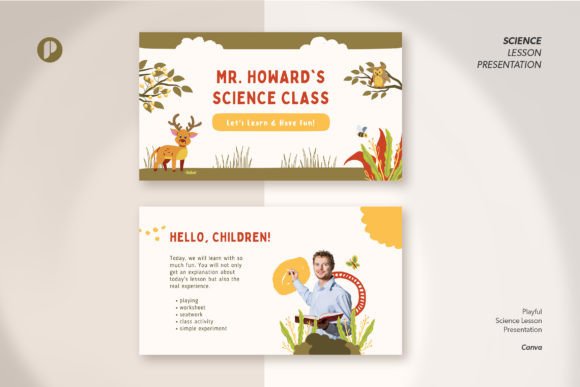
To address these challenges, we introduce the Floral White Playful Science Lesson Presentation Template. This resource is specially designed to help you deliver your materials in a fun and engaging manner. It serves as your best companion in solving the problem of student disengagement by combining educational rigor with artistic appeal.
This template creates a fun and playful impression for your presentation with a unique color combination and attractive illustrations. The "Floral White" theme is not merely decorative; it utilizes a clean, bright background that ensures high readability while incorporating natural elements that subtly reinforce scientific themes such as biology, ecology, and environmental science.
Key Features That Enhance Learning
- Informative Visual Support: The template includes informative images to support the content of your subject. These are not just filler graphics; they are curated to complement scientific explanations, making complex ideas easier to visualize.
- Symmetrical and Organized Layout: A well-organized and symmetrical layout makes your presentation even more understandable. Cognitive load theory suggests that cluttered slides overwhelm working memory. By maintaining balance and clear hierarchy, this template allows students to focus on the core message without distraction.
- Alluring Aesthetics: You can grab your students’ attention quickly with this alluring presentation template. The unique color palette blends soft whites with vibrant floral accents, creating a fresh and energetic atmosphere that stands out from typical monochrome slides.
Practical Application in the Modern Classroom
Integrating this template into your workflow is seamless, thanks to its compatibility with modern design tools. This presentation template is available in Canva format only, consisting of 15 unique designs for your presentation. Canva has become a staple in educational technology due to its user-friendly interface and collaborative features.
Upon purchase, you will get the link to the template in a PDF file so you can edit or customize the text, image, and color on the template using Canva. This flexibility is crucial for teachers who need to adapt materials to specific curriculum standards or student needs. Whether you are teaching photosynthesis, the solar system, or basic mechanics, the neutral yet playful foundation of the template allows for extensive customization.
Customization for Diverse Scientific Topics
One of the greatest strengths of this resource is its versatility. While the floral theme suggests a focus on life sciences, the clean layout and playful icons are equally effective for other branches of science. Here is how you might adapt the template for different subjects:
- Biology and Ecology: Use the existing floral illustrations to discuss plant structures, ecosystems, or biodiversity. The natural aesthetic aligns perfectly with these topics, reinforcing the content visually.
- Chemistry: Replace floral elements with molecular structures or lab equipment icons available in Canva’s library. The white background provides excellent contrast for colorful chemical equations and reaction diagrams.
- Physics: Utilize the symmetrical layout to demonstrate forces, motion, and energy transfer. The clean lines help in drawing vector diagrams or illustrating simple machines without visual clutter.
Strategies for Maximizing Impact
Having a beautiful template is only the first step. To truly leverage the Playful Science Lesson Presentation, consider these instructional strategies:
Interactive Storytelling: Use the 15 unique slides to build a narrative arc. Start with a question or a mystery, use the middle slides to explore evidence and experiments, and conclude with a revelation or summary. The consistent visual theme keeps students anchored in the story.
Visual Anchors: Assign specific icons or colors to key concepts. For example, always use a specific flower icon to represent "growth" or "change." This repetition helps students recognize patterns and recall information more effectively during assessments.
Student Participation: Since the template is editable in Canva, consider involving older students in the creation process. Allow them to add their own illustrations or modify colors for group projects. This active involvement deepens their understanding of the material and fosters ownership of their learning.
The Role of Design in Critical Thinking Development
It is important to recognize that engaging visuals do not dumb down the content. On the contrary, they facilitate higher-order thinking. When students are not struggling to decode poorly organized slides, they have more cognitive resources available for analysis, evaluation, and creation. The Floral White Playful Science Lesson Presentation Template supports this by removing barriers to comprehension.
By presenting information in a clear, attractive, and structured way, you encourage students to ask deeper questions. They move from wondering "What is this?" to asking "Why does this happen?" and "How can I apply this?" This shift is the hallmark of effective science education.
Conclusion: Investing in Educational Excellence
In an era where attention is a scarce resource, teachers must compete with countless digital distractions. The solution is not to ban technology or simplify content, but to elevate the presentation of that content. The Playful Science Lesson Presentation approach recognizes that how we teach is just as important as what we teach.
The Floral White template offers a practical, accessible, and aesthetically pleasing solution for educators committed to excellence. With its 15 unique designs, Canva compatibility, and thoughtful layout, it empowers teachers to create lessons that are not only informative but also inspiring. By adopting such tools, you are not just preparing a slide deck; you are crafting an experience that nurtures curiosity, sustains focus, and ultimately contributes to the development of critical thinkers ready to shape a better future.
Embrace the power of playful design. Transform your science lessons from mundane recitations into vibrant explorations. Your students’ engagement—and their understanding—will thank you.